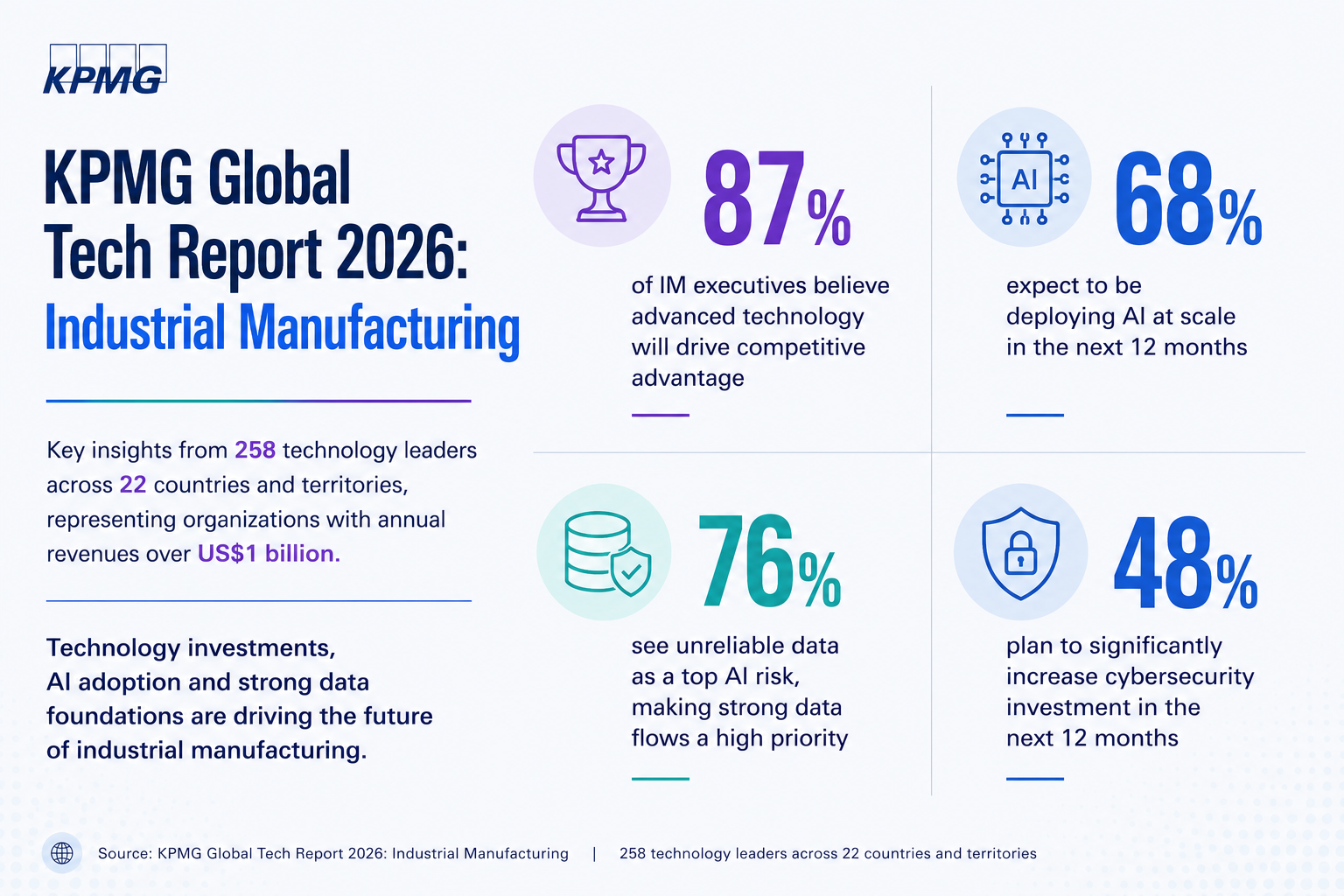
Recent insights from the KPMG Global Tech Report 2026: Industrial Manufacturing, draws responses from 258 technology leaders across 22 countries and territories, representing organizations with annual revenues exceeding US$1 billion.
The key finding suggests that industrial manufacturing sector is entering a new phase of digital transformation where technology is no longer viewed as a support function but as a core business enabler. The respondents include leadership personnel and senior technology executives from sectors including aerospace & defence, space, metals & advanced materials, and engineering products.
The report identifies three defining trends shaping the future of industrial manufacturing:
- Technology investments translating into tangible returns
- AI becoming embedded across business operations
- Robust data ecosystems emerging as the foundation for sustainable digital transformation.
TECHNOLOGY INVESTMENTS ARE BEGINNING TO PAY OFF
Industrial manufacturers are demonstrating greater confidence in technology investments than many other industries. According to the report, 87% of executives believe advanced technology will be a key driver of future competitive advantage, while 76% of respondents say their organizations are investing more than US$50 million in digital technologies.
More importantly, these investments are already delivering results, with 49% of organizations reporting significant financial gains. Thus, the emphasis is shifting beyond technology adoption to value realization. Manufacturers increasingly view digital investments as a means to improve operational efficiency.
Eighty percent of respondents indicate that technology frequently improves the value generated from business investments, despite continuing pressures from rising costs and technical debt. Strong digital infrastructure has also played an important role, with 54% of executives stating that their organizations already possess mature network and cloud capabilities, enabling faster deployment of advanced technologies.
The report also notes that supportive government policies are becoming important catalysts for digital transformation. In India, for instance, Budget 2026's long term tax incentives for data centres and digital infrastructure are expected to accelerate manufacturing digitization while attracting global cloud service providers to participate in the country's growing industrial ecosystem.
AI MOVES FROM PILOTS TO ENTERPRISE SCALE
The most significant finding of the report is that industrial manufacturing is progressing beyond isolated AI experiments toward enterprise-scale deployment. Nearly half (49%) of executives report active deployment of AI use cases that are already delivering business value.
The applications of AI are becoming increasingly practical and operationally focused. Predictive quality control emerges as the most widely adopted use case, followed by reducing equipment downtime, accelerating product customization through generative AI, predictive maintenance and supply chain optimization.
Rather than replacing manufacturing processes outright, AI is being integrated alongside sensors, industrial systems and connected devices to create more predictive, responsive and intelligent production environments. The report also highlights that around 70% of organizations have adopted centralized AI governance led by their IT teams.
Simultaneously, manufacturers are investing heavily in workforce preparedness. Nearly 89% believe managing AI agents will become a critical workplace skill over the next five years, and 81% have 42 already incorporated AI-native roles such as prompt engineers and AI ethicists into their talent acquisition strategies.
This reflects a broader realization that AI transformation extends beyond software implementation. Building employee confidence, redefining operating models and fostering collaboration between humans and intelligent systems will be equally important in maximizing long-term returns.
DATA QUALITY BECOMES THE REAL COMPETITIVE ADVANTAGE
While AI dominates industry conversations, the report repeatedly underscores that data and not algorithms will ultimately determine the success of digital transformation. Although 83% of executives believe their organizations are building strong AI data foundations, 76% still identify unreliable data as one of the biggest AI risks over the next two years.
This apparent contradiction reflects the complexity of manufacturing environments, where information often remains fragmented across legacy systems, production facilities and business functions. The report argues that organizations must continuously strengthen data governance, improve interoperability between systems and establish reliable enterprise-wide data flows before AI can consistently deliver meaningful outcomes.
Alongside data, cybersecurity is becoming inseparable from digital transformation. With 48% of executives planning significant increases in cybersecurity investment over the coming year, manufacturers increasingly recognize that protecting connected operations is as important as digitizing them.
BUILDING INTELLIGENT MANUFACTURING ECOSYSTEMS
The report makes it clear that industrial manufacturing has moved beyond asking whether AI will create value. Manufacturers that combine strategic technology investments with enterprise-wide AI adoption & resilient cybersecurity frameworks are likely to be best positioned to navigate an increasing global uncertainties.
As digital twins and AI continue to converge, the competitive advantage will belong to those integrating them into an intelligent manufacturing ecosystem capable of delivering measurable business outcomes.