India's renewable energy journey has often been measured in gigawatts added and targets achieved. The latest milestone of becoming the world's third largest country in renewable energy installed capacity, according to the International Renewable Energy Agency (IRENA) adds another impressive statistic to that journey.
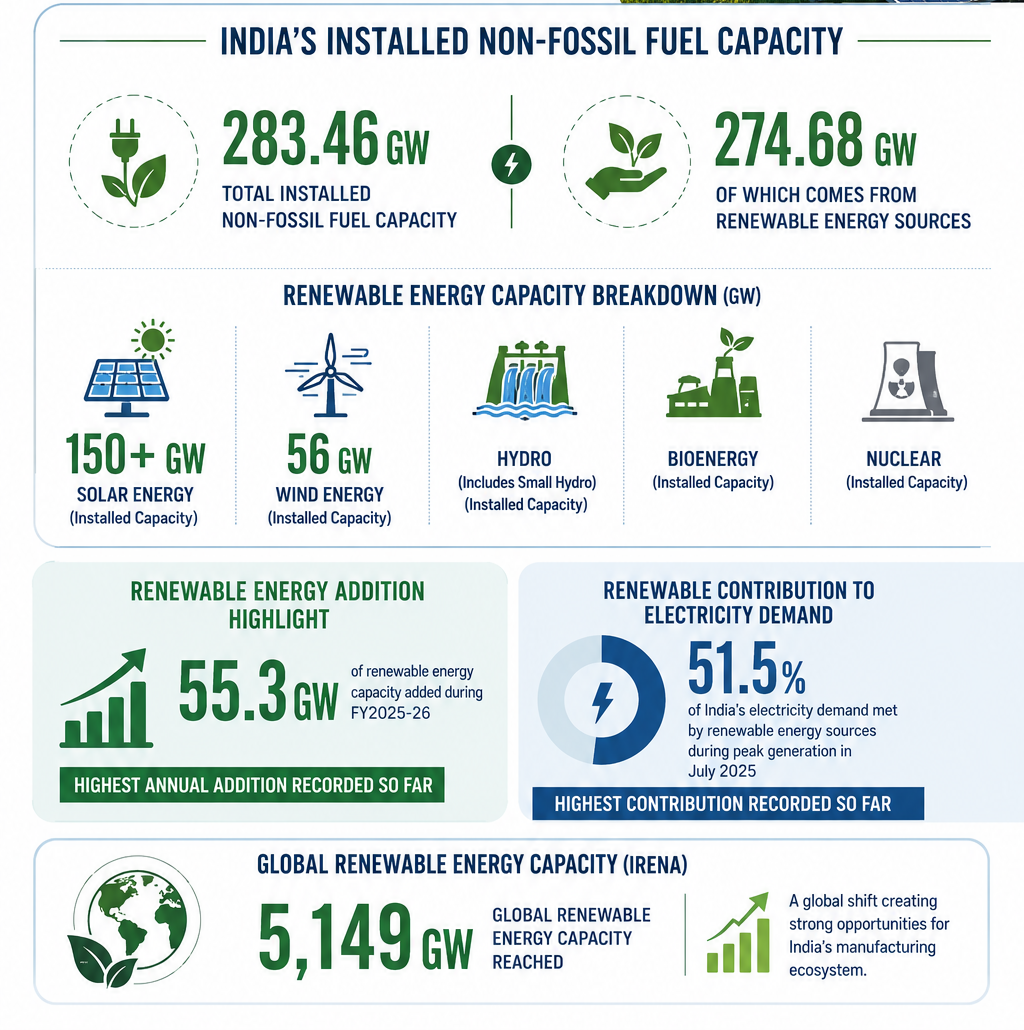
The latest figures released by the Ministry of New and Renewable Energy (MNRE) illustrate this transformation. India now has 283.46 GW of installed non-fossil fuel capacity, of which 274.68 GW comes 48 from renewable energy sources.
Solar energy continues to lead the expansion with over 150 GW of installed capacity, followed by wind at 56 GW, while hydro, bioenergy and nuclear continue to strengthen the country's diversified energy mix.
Equally significant is the pace of deployment. During FY2025 26 alone, India added 55.3 GW of renewable energy capacity which is the highest annual addition recorded so far. This reflects the accelerated implementation of utility-scale projects and continued investments across the clean energy ecosystem.
FROM CAPACITY ADDITION TO ECONOMIC VALUE CREATION
Every new solar park, wind project or hybrid renewable installation generates demand across a wide industrial value chain. From photovoltaic modules and wind turbines to transformers, switchgear, cables, power electronics, energy storage systems and transmission infrastructure, renewable energy has become a catalyst for manufacturing activity across multiple sectors. This multiplier effect extends well beyond power generation.
Engineering services, project management, logistics, financing, digital monitoring systems and EPC contractors all form part of an expanding ecosystem that is supporting employment generation while creating new avenues for domestic manufacturing.
Another important implication of India's renewable energy expansion is its contribution to long-term energy security. Historically, India's energy requirements have been closely linked to imported fossil fuels, exposing the economy to global commodity price volatility and geopolitical disruptions.
Therefore, a larger renewable energy base enables the country to diversify its energy portfolio while gradually reducing dependence on imports. The government's latest data highlights this transition.
In July 2025, renewable energy sources met 51.5% of India's electricity demand during peak generation, marking the highest contribution recorded so far. These figures demonstrate the increasing ability of renewable energy to support the national grid during periods of high demand.
In fact, for industries, greater renewable integration translates into improved energy availability and stronger alignment with corporate sustainability commitments that are increasingly influencing global investment decisions.
THE MANUFACTURING OPPORTUNITY
IRENA's Renewable Energy Statistics 2026 shows that the global renewable energy capacity reached 5,149 GW. This has important implications for the broader manufacturing ecosystem, especially for countries like India. As global economies diversify clean energy supply chains, India is positioning itself as both a major consumer and a manufacturing hub for renewable energy equipment.
The global demand is expected to increase for electrical equipment manufacturers, component suppliers, automation companies, precision engineering firms, and battery manufacturers.
The growth of renewable energy is therefore generating opportunities that extend well beyond the power sector, strengthening India's ambition of becoming a globally competitive manufacturing destination. In many aspects, renewable energy is now becoming an industrial policy lever as much as an environmental initiative.
WHAT'S THE FUTURE LIKE
Despite the impressive growth in installed capacity, the renewable energy transition remains a work in progress. While non-fossil sources now account for over half of India's installed electricity capacity, their contribution to actual electricity generation remains lower due to the intermittent nature of solar and wind power.
Coal continues to provide the majority of baseload electricity required to maintain grid stability. Future investments will increasingly focus on battery energy storage systems, pumped hydro storage, smart grids, flexible transmission networks and digital grid management.
These technologies will be critical in ensuring that higher renewable capacity translates into higher renewable electricity generation while maintaining grid reliability. However, the conversation needs to gradually shift from how much renewable capacity India can install to how efficiently the energy system can integrate and utilise it.
For businesses, this transition presents new opportunities across manufacturing, infrastructure, engineering and technology. For policymakers, it validates years of sustained investments and policy support. For investors, it reinforces confidence in one of the world's fastest-growing clean energy markets.
This latest milestone, therefore, should not be viewed merely as an increase in installed capacity. It represents the evolution of renewable energy from an environmental concern into a strategic pillar of India's economic growth.