The 2026 Pulse of Quality in Manufacturing report, conducted by Censuswide on behalf of Octave Reliance, offers a detailed snapshot of how manufacturers are responding to mounting operational and economic pressures. The survey gathered responses from 2,263 quality professionals, managers and directors working in manufacturing firms with 1,000 to more than 50,000 employees across the United States, United Kingdom and Germany between late 2025 and early 2026.
The respondent base spans industries including automotive, heavy manufacturing, transportation, aerospace & defense, pharmaceuticals and consumer goods, making the findings broadly representative of large scale industrial operations. The report findings suggest that quality is increasingly being treated as a strategic capability that influences revenue and long-term competitiveness.
WORKFORCE SHORTAGES ARE NOW A QUALITY ISSUE
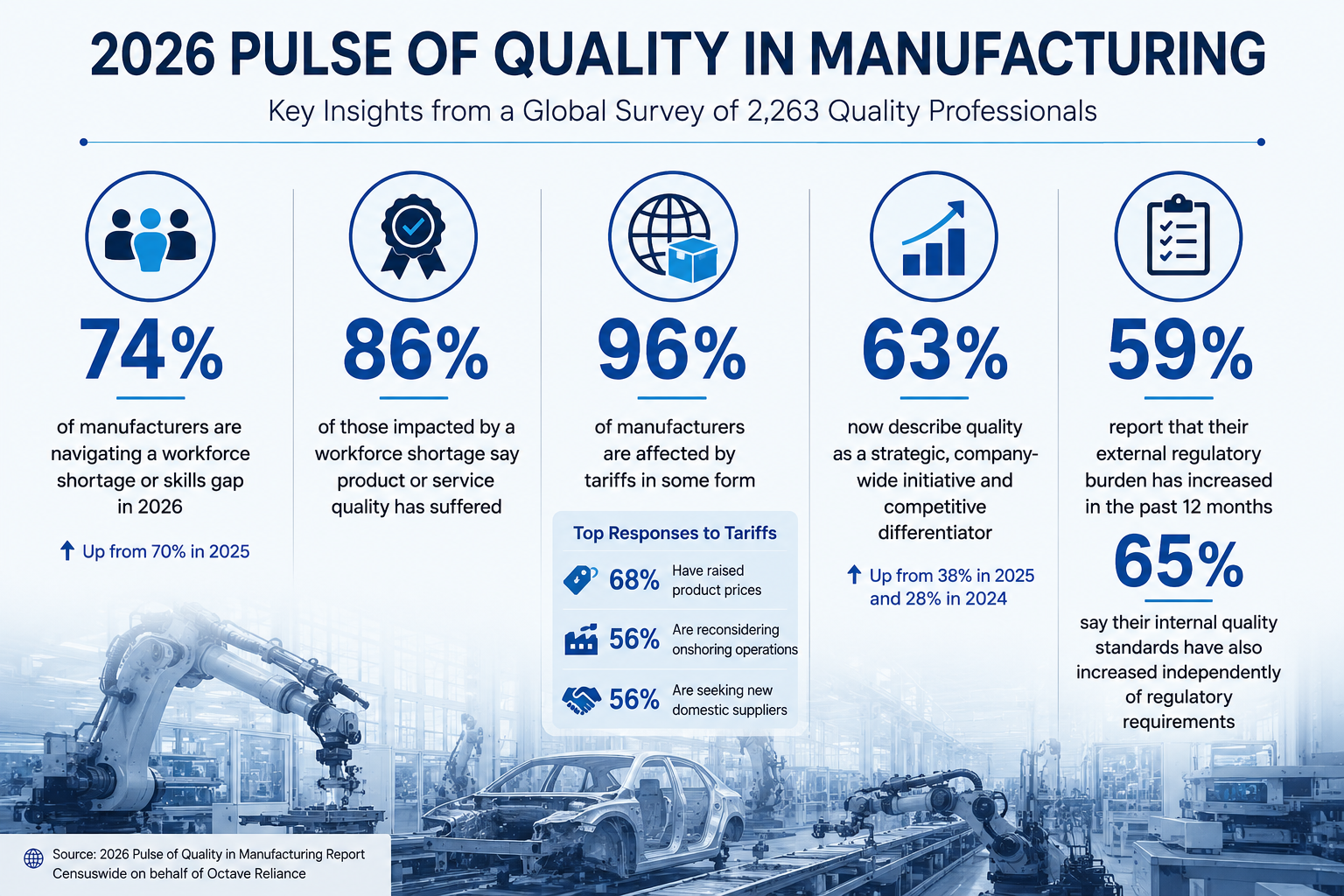
One of the clearest signals from the survey is the persistence of the manufacturing skills gap. 74% of manufacturers say they are still navigating a workforce shortage or skills gap. The report attributes this to experienced workers retiring faster than they can be replaced and to the growing digital and data-driven skill requirements of modern plants.
More importantly, the shortage is no longer being viewed solely as an HR problem. Among manufacturers experiencing a skills gap, 86% say product or service quality has suffered as a result. This has direct implications for scrap rates, rework, customer complaints, compliance exposure and brand reputation.
For manufacturers, the message is clear: workforce planning and quality management can no longer be addressed in separate silos. Investments in training, knowledge retention and digital work instructions are becoming essential quality safeguards.
TARIFFS ARE RESHAPING OPERATIONAL DECISIONS
The report also identifies trade tariffs and geopolitical disruption as a second major external force. Ninety six percent of manufacturers report being affected by tariffs in some form, with 56% saying the impact has been significant.
These numbers indicate that most manufacturers are choosing adaptation over retrenchment. However, changing suppliers or relocating production introduces new quality risks, including supplier qualification challenges, inconsistent incoming material quality and additional audit requirements.
The survey highlights that tariff mitigation strategies must be accompanied by stronger supplier quality management processes if manufacturers want to avoid downstream failures. Similarly, a notable shift in executive thinking emerges from the survey.
63% percent of manufacturers now describe quality as a strategic, company-wide initiative and competitive differentiator, up sharply from 38% in 2025. This change matters because it influences funding decisions.
Organizations that view quality as a strategic capability are more likely to protect or expand quality investments even during periods of margin pressure. The survey shows that 65% of manufacturers are increasing quality spending in 2026, with particular regional differences: 71% of U.S. manufacturers are increasing quality spend, compared with 68% in the U.K. and 50% in Germany.
COST OF FAILURE IS TOO HIGH
The survey states that about 74% of manufacturers experienced a product recall during the past five years, a figure that has remained relatively stable. However, the cost of those recalls is increasing: more than two thirds of affected manufacturers spent $10 million or more to rectify their most recent recall.
The report further shows that 45% of recalls were attributed to internal actions and 42% to supplier issues. Stronger quality systems can therefore reduce both internal defects and supplier-related failures. These quality issues further pave way for manufacturers who are now turning to artificial intelligence for quality improvisation.
47% are already using AI and in total, 90% are either using AI or preparing to do so. The most common applications include document processing (47%), staff training and retention (46%), core process automation (46%) and defect detection (42%).
These numbers suggest that AI is moving beyond experimentation and becoming a practical tool for reducing compliance workload, preserving institutional knowledge and improving process consistency.
WHY SUCH SURVEYS MATTER
For manufacturing leaders, these reports provide early visibility into where competitors are investing, how regulatory and trade pressures are evolving, and which operational risks are becoming systemic across the industry. The broader takeaway is that quality is moving steadily toward the core of manufacturing organizations.
Manufacturers that treat quality as a strategic capability rather than a compliance obligation will be better positioned to protect margins, strengthen supply chains and compete in an increasingly complex industrial environment.