India's defence story over the past decade has been defined beyond higher budgets. It is the nation's decisive action on the battlefield. From the Surgical Strikes (2016) & Balakot Air Strike (2019) that redefined India's response to cross-border terrorism to Operation Sindoor (2025), which demonstrated the country's ability to execute technology-driven military operations, India has signalled a new era of strategic confidence. These operations have drawn tremendous global attention to the capabilities of its armed forces and the determined strength of its indigenous defence ecosystem. Behind these high-profile military successes lies years of investment in manufacturing, policy reformations & much more.
The Self-Reliance Push
Over the past decade, India's defence sector has undergone a remarkable transformation. What was once largely dependent on imports is steadily evolving into a robust ecosystem backed by the vision of Aatmanirbhar Bharat. Investments in indigenous manufacturing, research and development, policy reforms and private sector participation have gradually built the foundation for a self-reliant military-industrial base.
Recent data released by the Ministry of Defence highlights the magnitude of this transformation. One of the strongest indicators of this commitment is the substantial increase in defence spending. India's defence budget has risen from ₹2.53 lakh crore in FY2013-14 to ₹7.85 lakh crore in FY2026-27, making it the highest-ever allocation for the sector. The increased investment is supporting force modernisation, infrastructure development, capability enhancement and research initiatives across the Army, Navy and Air Force. It also reflects the government's long-term strategy of strengthening national security amid geopolitical challenges.
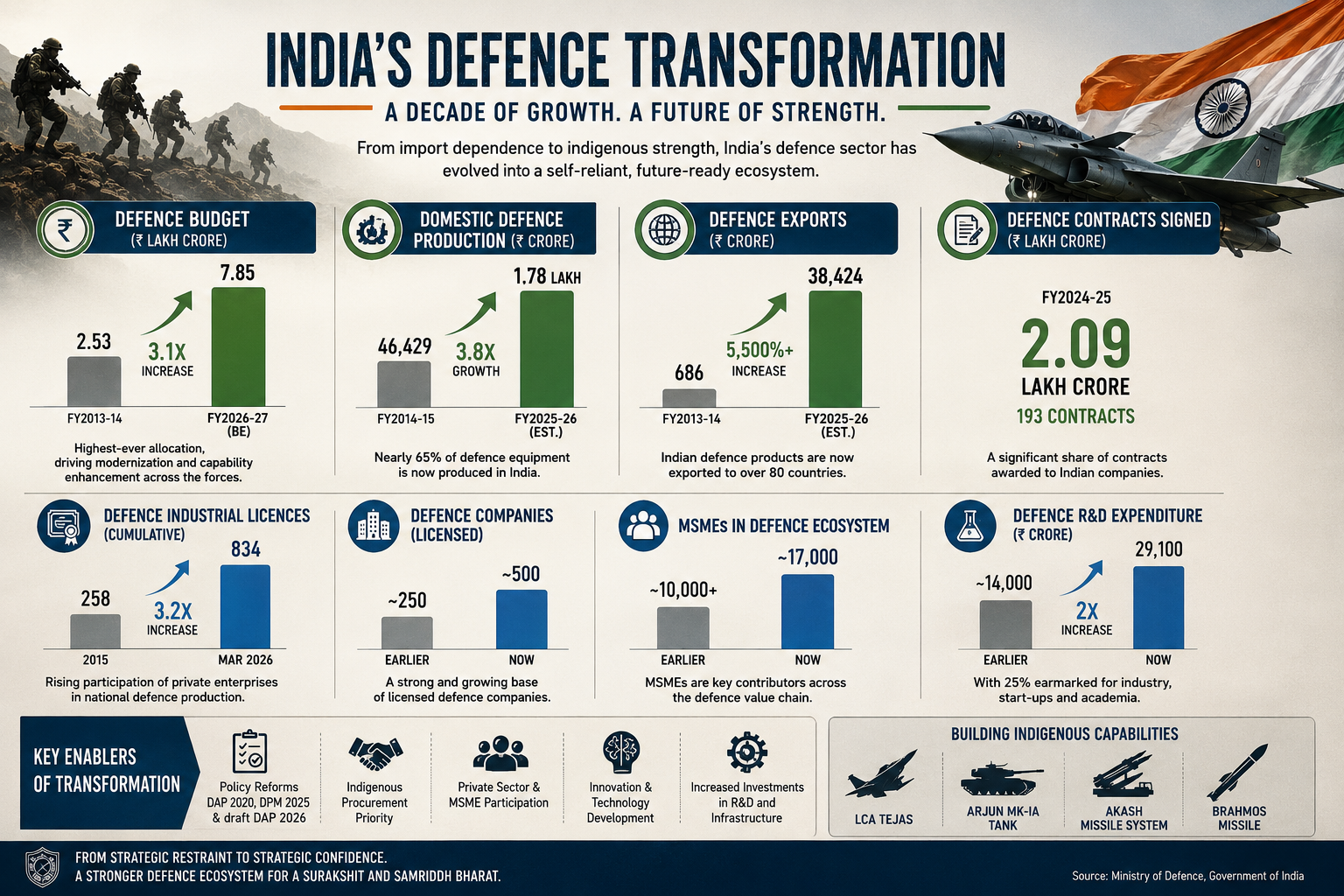
Parallel to the budgetary rise is an expansion in domestic defence manufacturing. India's defence production has grown from ₹46,429 crore in FY2014-15 to an estimated ₹1.78 lakh crore in FY2025-26. Today, nearly 65% of defence equipment is produced within the country, a notable shift from the earlier dependence on imported platforms and systems. This transition has been driven by indigenous procurement policies, greater participation of the private sector and consistent support for domestic manufacturers.
Perhaps one of the most remarkable outcomes of this transition has been India's emergence as a defence exporter. From just ₹686 crore in FY2013-14, exports have reached a record ₹38,424 crore in FY2025-26—an increase of more than 5,500%. Indian-made defence equipment is now being exported to over 80 countries, demonstrating growing international confidence in the quality and competitiveness of indigenous defence products.
Manufacturing Strength Meets Policy Momentum
Policy reforms have played a pivotal role in enabling this transformation. Initiatives such as the Defence Acquisition Procedure (DAP) 2020, Defence Procurement Manual (DPM) 2025 and the draft DAP 2026 have prioritised indigenous procurement and simplified acquisition processes. During FY2024-25 alone, the Ministry of Defence signed 193 defence contracts worth nearly ₹2.09 lakh crore, with a significant share awarded to Indian companies. These reforms have created a more predictable and industry-friendly environment while encouraging long-term investments in defence manufacturing.
Similarly, India's defence industrial ecosystem has also expanded considerably over the years. The country now has 16 Defence Public Sector Undertakings (DPSUs), around 500 licensed defence companies and nearly 17,000 MSMEs contributing to the sector. In fact, MSMEs have emerged as critical suppliers within the defence value chain, supporting component manufacturing, specialised engineering and advanced technologies. Defence industrial licences have also increased from 258 in 2015 to 834 by March 2026, highlighting the growing participation of private enterprises in national defence production.
Vision for Modern Warfare
Innovation and research have become key pillars of India's defence transformation. Through initiatives such as Innovations for Defence Excellence (iDEX) and the Technology Development Fund (TDF), the government has strengthened collaboration between start-ups, academia and industry. Backed by a doubling of defence R&D expenditure to ₹29,100.25 crore, with 25% earmarked for industry, start-ups and academia, these initiatives are accelerating innovation in AI, autonomous systems, and electronic warfare while reducing dependence on foreign technologies.
With a substantial R&D expenditure and programmes for innovation, India's technological ambitions are also becoming increasingly evident. Indigenous platforms such as the Light Combat Aircraft Tejas, Arjun Mk-IA main battle tank, Akash missile system and BrahMos supersonic cruise missile continue to strengthen the country's operational preparedness. Simultaneously, successful milestones such as the scramjet combustor test, the establishment of a Hypersonic Wind Tunnel and progress in AI-enabled defence systems reflect India's focus on developing capabilities relevant to future warfare.
Confidence Backed by Capability
Operational readiness also received a significant boost through indigenous strategic capabilities. Programmes such as Mission Shakti, anti-drone technologies, India's anti-satellite weapon demonstration, and Mission Divyastra are enhancing the armed forces' preparedness to identify and address emerging security challenges across multiple domains.
The true measure of India's defence transformation lies in the strategic confidence it inspires. India has long projected itself as a nation that believes in dialogue over conflict. But today's geopolitical realities demand more. As India continues to build its global influence through diplomacy, a stronger defence industry ensures it is equally prepared to protect its interests whenever the need arises.