India's industrial story is beginning to sound more confident again. The latest data from the Ministry of Statistics and Programme Implementation shows that industrial output, measured by the Index of Industrial Production, grew 5.2 percent in February 2026, up from 4.8 percent in January.
On the surface, this looks like a modest uptick. But beneath that number lies a more important signal. Manufacturing, long seen as the backbone of India's economic ambitions, is quietly regaining momentum.
The Manufacturing Engine Is Doing the Heavy Lifting
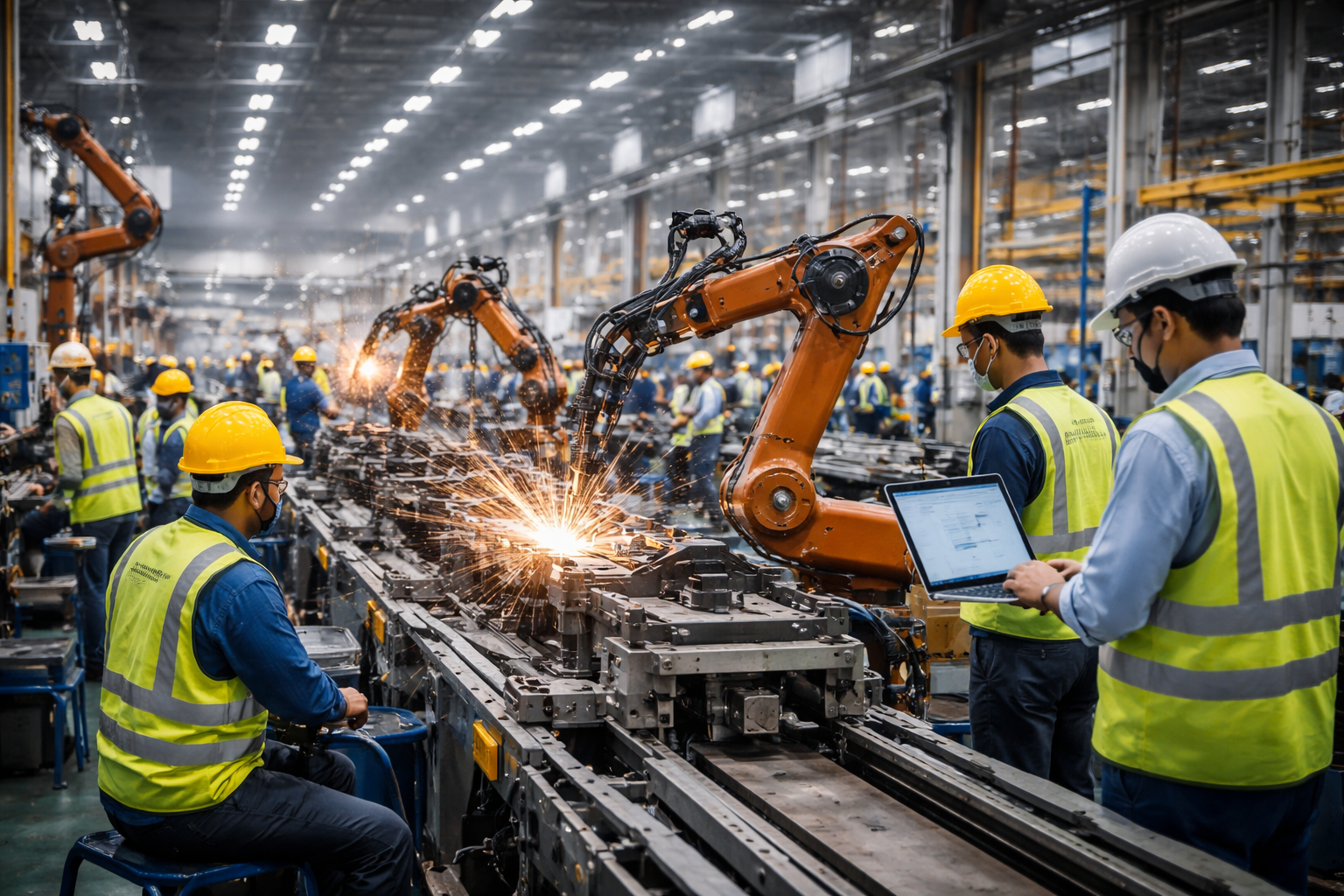
The biggest contributor to this growth is manufacturing, which expanded by 6 percent in February, significantly outpacing mining and electricity.
What makes this more meaningful is the spread of growth. A majority of manufacturing segments reported positive expansion, with sectors like automobiles, basic metals, and machinery leading the charge.
This tells us something important. Growth is not being driven by one or two outliers. Instead, it is becoming more broad-based, reflecting stronger underlying demand across industries.
There are visible signs of this on the ground. Rising output in steel products and machinery points to continued infrastructure activity. Strong performance in automobiles suggests both domestic demand and supply chain stability are holding up. These are not just isolated data points. They are indicators of a system that is slowly finding balance after years of disruption.
Investment Is Beginning to Show Up
Another encouraging aspect of the data is the performance of capital goods and infrastructure-related segments. Capital goods grew by over 12 percent, while infrastructure and construction goods saw double-digit expansion.
These numbers matter because they reflect investment activity. When companies start buying machinery and building capacity, it signals confidence in future demand. It also suggests that the private sector, which had been cautious for some time, may be slowly stepping back into the investment cycle.
For an economy like India, this shift is critical. Consumption can drive growth for a while, but sustained expansion requires investment. And investment, in turn, feeds manufacturing.
A Story of Momentum, Not a Breakout
At the same time, it is important to keep the bigger picture in mind. A growth rate of 5.2 percent is solid, but not extraordinary. It points to stability rather than a breakout.
In fact, some parts of the economy are still under pressure. Consumer non-durables, which include everyday goods, have shown weak or even negative growth in some segments.
This reflects a more uneven recovery, where demand at the lower end of the consumption spectrum remains fragile. It is a reminder that while the headline numbers are improving, the recovery is not yet fully inclusive.

Global Winds Still Matter
India's industrial momentum is also unfolding in a complex global environment. Supply chains are being reshaped, geopolitical tensions remain elevated, and input costs continue to fluctuate.
Recent reports have flagged potential risks from global conflicts and disruptions, particularly in regions that influence energy prices and trade flows.
For Indian manufacturers, this creates both opportunity and uncertainty. On one hand, companies are looking to diversify supply chains and reduce dependence on single geographies, which could benefit India. On the other hand, volatility in global markets can quickly affect costs, exports, and production planning.
The Real Question Is Sustainability
So where does this leave India's industrial story?
The current data suggests resilience. Manufacturing is holding up, investment is showing early signs of revival, and industrial output is maintaining a steady pace. Compared to a year ago, when growth had slowed sharply to below 3 percent, the improvement is notable.
But the more important question is whether this momentum can be sustained.
For that to happen, a few things need to align. Demand, both domestic and global, has to remain stable. Investment needs to deepen beyond early signals. And productivity gains, driven by technology and efficiency, must continue to improve.
There is also a structural layer to this conversation. India's ambition to become a global manufacturing hub depends not just on growth numbers, but on consistency. Businesses need predictability, supply chains need reliability, and policy support needs to be steady.
A Quiet Turning Point
What February's data really represents is not a dramatic surge, but something more subtle. It signals a gradual strengthening of the industrial base.
Manufacturing is not booming, but it is no longer struggling. Investment is not surging, but it is beginning to return. Growth is not spectacular, but it is steady.
In many ways, this is what a healthy recovery looks like. Not a spike, but a rhythm.
And if that rhythm holds, India's manufacturing story may finally begin to move from potential to performance.