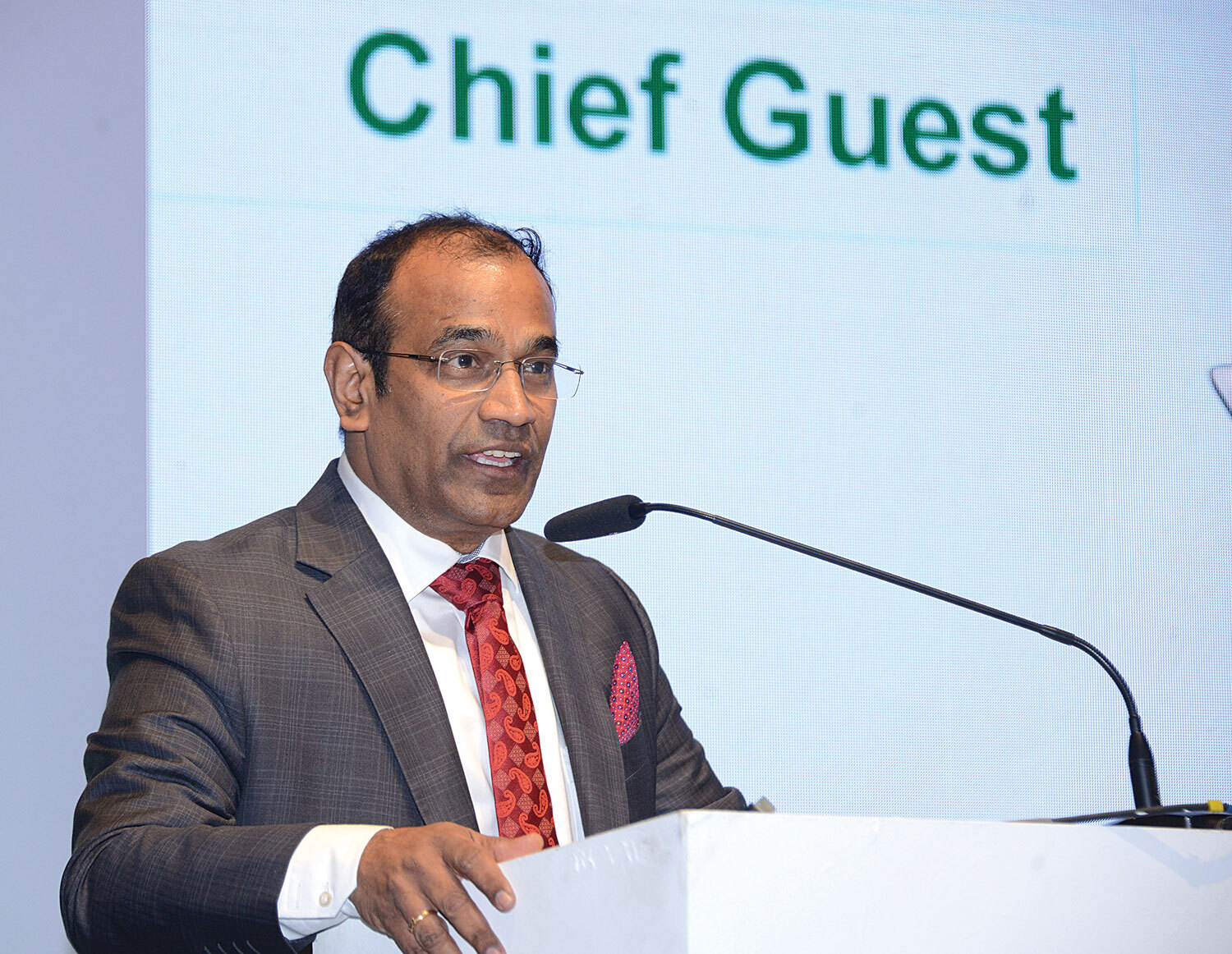
When Ganesh Mani speaks about growth, he does not talk in cautious terms or offer conditional predictions. He talks in clear, confident statements that leave little room for ambiguity. His conviction is unmistakable as he outlines Switch Mobility's path for the next five years. "Our dream is to double every year" he says, describing a level of growth that most companies would hesitate to even imagine. But hesitation is not something Mani appears to carry with him.
In his dual role as the CEO of Switch Mobility and the President and Chief Operating Officer of Ashok Leyland, he stands at a rare intersection in the automotive world. On one side is Ashok Leyland, a seventy-seven-year-old institution with deep roots, decades of trust and ten companies under its umbrella. On the other is Switch Mobility, a much younger and intensely fast-moving entity that is trying to build the future at start up speed. Mani describes the relationship almost like a bridge between deep experience and youthful energy. Ashok Leyland brings the knowledge, the maturity and an ecosystem built over generations while Switch brings rapid innovation, shorter cycle times and the urgency needed in the expanding world of electric mobility. Together, they form the kind of partnership that could reshape electric mobility in India.
It is no surprise that Mani carries both responsibilities with clarity. He views them not as competing demands but as complementary engines that can propel each other forward. His experience at Ashok Leyland becomes a solid foundation for Switch Mobility and Switch's agile approach becomes an invaluable catalyst for the legacy company's transformation into the EV era.

One of the most significant milestones for Switch Mobility came recently when the company achieved an EBITDA break even in 2025. The milestone was not marginal. Switch closed the last quarter with a double-digit EBITDA of 12 percent. The first half of the year was positive not only at the EBITDA level but also at the PAT level. For an EV company still operating in what Mani describes as a startup environment, the achievement speaks volumes. Mani attributes this success to the right product models, a disciplined preparation for future industry trends and a focus on entering the market quickly with offerings that matter.
Speed is a recurring theme in his vision. Whether it is manufacturing cycles, product launches or market response, Mani believes that Switch Mobility must operate with pace. He intends to make that pace the company's competitive advantage. The bus segment is already reflecting the benefits of this approach. Switch has more than two thousand electric buses running across different regions and the feedback from customers has been positive. The company also has a strong pipeline of orders with additional deployments planned in the near term. Their buses are already operating in Mauritius, and more international markets are in sight this year.
Switch's ambition does not stop at buses. The company is working on expanding its offerings in the light commercial vehicle space, primarily in the less than seven-point five-ton category. This is familiar territory for Ashok Leyland, which has been a market leader in the three-point five-ton range for years. Mani plans to maintain that leadership by launching new products at an aggressive rhythm. His target is clear. He wants a new product every quarter. This is the kind of cadence usually associated with technology companies rather than automotive manufacturers, but Mani believes the EV market demands exactly this level of responsiveness.
He also explains that Switch must address three key customer groups. The first is the B2B segment, which forms a major part of the commercial vehicle landscape. The second is the B2G segment, where government tenders and public mobility programs are accelerating the adoption of electric vehicles. The third is the B2C segment, where direct buyers are becoming increasingly interested in cleaner and more efficient transport solutions. Switch wants its products to be reliable, customised and highly efficient so that each of these customer groups finds a clear value proposition.
Scaling production will be supported by one of the company's most exciting developments. A new state of the art manufacturing plant is coming up in Uttar Pradesh near Lucknow. Mani describes it as a global benchmark facility, and it is expected to be inaugurated soon. The plant includes unique features such as double decker robotic painting systems and conveyor based automatic metrology. These capabilities will significantly enhance production speed and precision and will allow Switch Mobility to convert its order book into deliveries faster. The company also intends to participate more actively in central and state government tenders as EV adoption expands across regions.

On the product roadmap front, Switch is currently centred on city buses starting with a fully customisable 12-meter platform. The company is now preparing to launch a new 9-meter flagship product which will evolve into school bus and staff bus versions. Mani also mentions upcoming intercity travel bus models which will open the door to retail buyers beyond institutional tenders. In the light commercial vehicle space, switch plans to introduce a variety of new products as the market demands while ensuring that development cycle times remain as short as possible.
Sustainability is another area where the company has real numbers to show. Switch Mobility's vehicles have already completed more than two hundred million electric kilometres. This has resulted in a reduction of over one hundred and fifty thousand kilograms of carbon emissions. Mani believes the company is still only at the beginning. His goal is to multiply this impact ten times in the shortest possible period. He attributes this confidence to the growing support from both central and state governments and to a maturing ecosystem of suppliers, dealer networks and service partners. Switch plans to strengthen both domestic and international dealership bases so that it is ready to scale as the market accelerates.
As the industry expands, retaining talent becomes essential. Mani calls electrification the dream domain for young engineers. The challenge is that specialised skills in batteries, power electronics and EMS are in short supply. To tackle this, Switch Mobility is working closely with academic institutions including IITs, NITs, engineering colleges, diploma institutes and ITIs. The company sends its teams to mentor students and invites learners to its facilities for first hand exposure. Mani explains that Switch has an R and D team of more than one thousand engineers who actively mentor new talent. He believes this academic partnership model will help create a strong innovation pipeline for the company and for the broader EV industry.
Looking ahead to 2030, Mani's vision for Switch Mobility is neither tentative nor incremental. It is bold and clearly defined. Last year, the company operated at less than one thousand crores. This year it will double that number. And every year after that, Mani wants the organisation to double again. It is an aggressive target, but he believes the team is completely aligned with it. To him, growth is not an abstract aspiration.